


We’re living in a time where information is constant, expectations are high, and the stakes of communication are often significant. Across sectors, organizations are tasked with delivering information that is not only accurate, but immediately understandable and actionable. In that context, clarity isn’t just a nice-to-have. It’s a strategic requirement.
Writing for understanding and clarity means more than simplifying language. It requires asking the right questions:
- Who is this for?
- What do they need to know?
- What action should they take?
- What might be confusing or unclear?
It’s about making sure people can find, process, and trust the information they’re given.
Without that foundation, even well-written content can miss the mark. When done well, clear communication doesn’t just inform, it builds confidence, reduces confusion, and helps audiences take meaningful action.
Clarity as a Driver of Trust
When messages are overly technical, filled with jargon, or difficult to follow, audiences can feel excluded or thrown off. Even when the intent is good, unclear communication creates distance between the messenger and receiver.
Writing that signals transparency and shows respect for the audience’s time and attention does the opposite. It helps people feel confident that they understand what’s being shared and are more likely to engage.
Reducing Misinformation Starts with Better Communication
In a fast-moving information landscape, gaps in understanding can quickly turn into misinformation. When people don’t have access to clear, accurate, and easy-to-understand information, they often fill in the gaps themselves or turn to less reliable sources.
By using plain language, anticipating questions, and structuring information in a way that’s easy to follow, organizations can reduce ambiguity and make it easier for audiences to find what they need the first time. This is not just a communications issue; it’s a risk management consideration. Clear messaging reduces the likelihood of confusion, misapplication, and missed opportunities for engagement.
Accessibility Is More Than Compliance
Accessibility is often thought of in terms of requirements, standards to meet, or boxes to check. But at its core, accessibility is about inclusion.
When communication is designed to be understood by a broader audience, including individuals with varying literacy levels, language proficiency, or cognitive needs, it extends reach and effectiveness. This is especially important in digital environments, where users tend to skim and navigate content quickly.
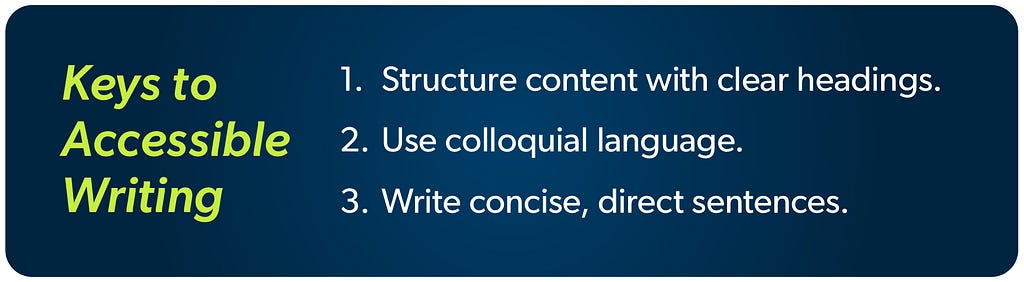
In practice this means structuring content with clear headings to allow users to quickly scan for relevant information, using colloquial language to ensure that key messages are not lost in technical terminology, and writing concise sentences to improve comprehension across devices and formats.
When communication is accessible, more people can engage with it and benefit from it.
Writing for understanding is more than a best practice. It’s a commitment to making communication more human, more effective, and more impactful for the people it’s meant to serve.