

As creatives in the federal space, we carry responsibility to communicate with the public, but this doesn’t necessitate rigidity. We’re not curing cancer. We’re not tasked with world peace. We’re communicating about federal initiatives and helping the public understand them. That’s important work, but it’s not so fragile that it can’t withstand iteration. In fact, that responsibility provides latitude. It gives us the ability to explore thoughtfully, test ideas in low-risk ways, and let performance build trust.
From Default to Deliberate
There are always going to be clients that want to stick to tried-and-true, clean and professional… perhaps just government blue. And that’s okay, we’re happy to oblige. But often we see clients stick with these default choices because they’re not seeing something different that resonates.
That said, sometimes what the client is asking for isn’t necessarily what the client needs. And that’s where exploration matters. When we earn a little latitude to try something new and let the metrics point to success, that success earns us more creative flexibility. Exploration builds trust and trust builds impact.
The Responsibility of Creative Leadership
When developing creative, it’s on our leaders to stay the course. That means maintaining faith, energy, and excitement around seeking creativity — especially if it’s a client initiative they’ve worked on for a long time. Getting caught up in every piece of feedback provided over the years will box you into a corner. Trends change. Client decision-makers change. Administrations change. Even when a key stakeholder prefers that we stay firmly in the lines or lean into one specific aesthetic, the biggest test of endurance is making sure we continue to bring fresh energy into the next project, client, or opportunity.
As creative leaders, we’re responsible for setting the vision and point of view. It gives teams direction and clients confidence. But if we get too stuck on our own vision, we lose opportunities for innovation. The joy of being part of a team of creatives is the influence and inspiration we get from one another. Something a designer brings to the table can completely shift the vision in a new and inspired way.
Creativity Beyond the Graphic
The design of a graphic alone doesn’t determine its success. It’s where it goes, how it’s delivered, and who it’s targeting. That’s why ongoing relationships with our data/analytics and paid media teams are so important.
Some of our greatest successes and most thoughtful developments have been because of this cross-collaboration:
- Hotel door hangers that target hotel staff to spot human trafficking
- Text messages that target rideshare drivers in a targeted area
- Mobile billboard trucks that drive around a highly attended event location

Copy that speaks directly to defined audiences — hotel workers, uber drivers, event attendees, etc. instead of generic “general public” language — garner results that prove resonance, higher engagement, and marked increases in audience behavior change.
When creative, data, and media teams are in conversation early, the work evolves in more intentional ways, with sharper briefs, more clearly defined audiences, and executions that are mission-driven rather than reactive.
Creating Within Constraints is Where Creativity Happens
There’s something deeply satisfying about building something fresh inside a framework that feels fixed. The structure challenges us to find originality where others might only see limitation.
You’ll see this originality come through in subtle but powerful ways:
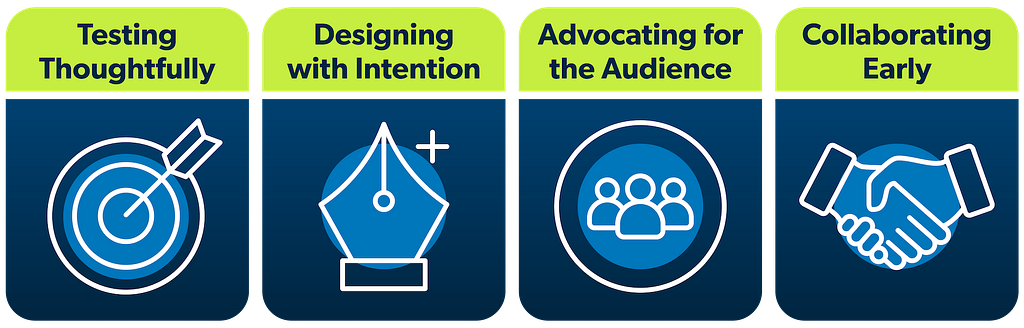
- Testing thoughtfully. Piloting new formats, layouts, or storytelling approaches in low-risk ways before scaling.
- Designing with intention. Using research and data to support creative decisions.
- Advocating for the audience. Grounding ideas in user needs to strengthen alignment and approval.
- Collaborating early. Bringing compliance, accessibility, data, and key stakeholders into the conversation from the start.
Innovation doesn’t have to be disruptive to be meaningful. Often, it’s iterative. And in federal work especially, iteration is where creative confidence and real impact is built.